Single-channel HD Video, color, sound, 10min. 48sec.
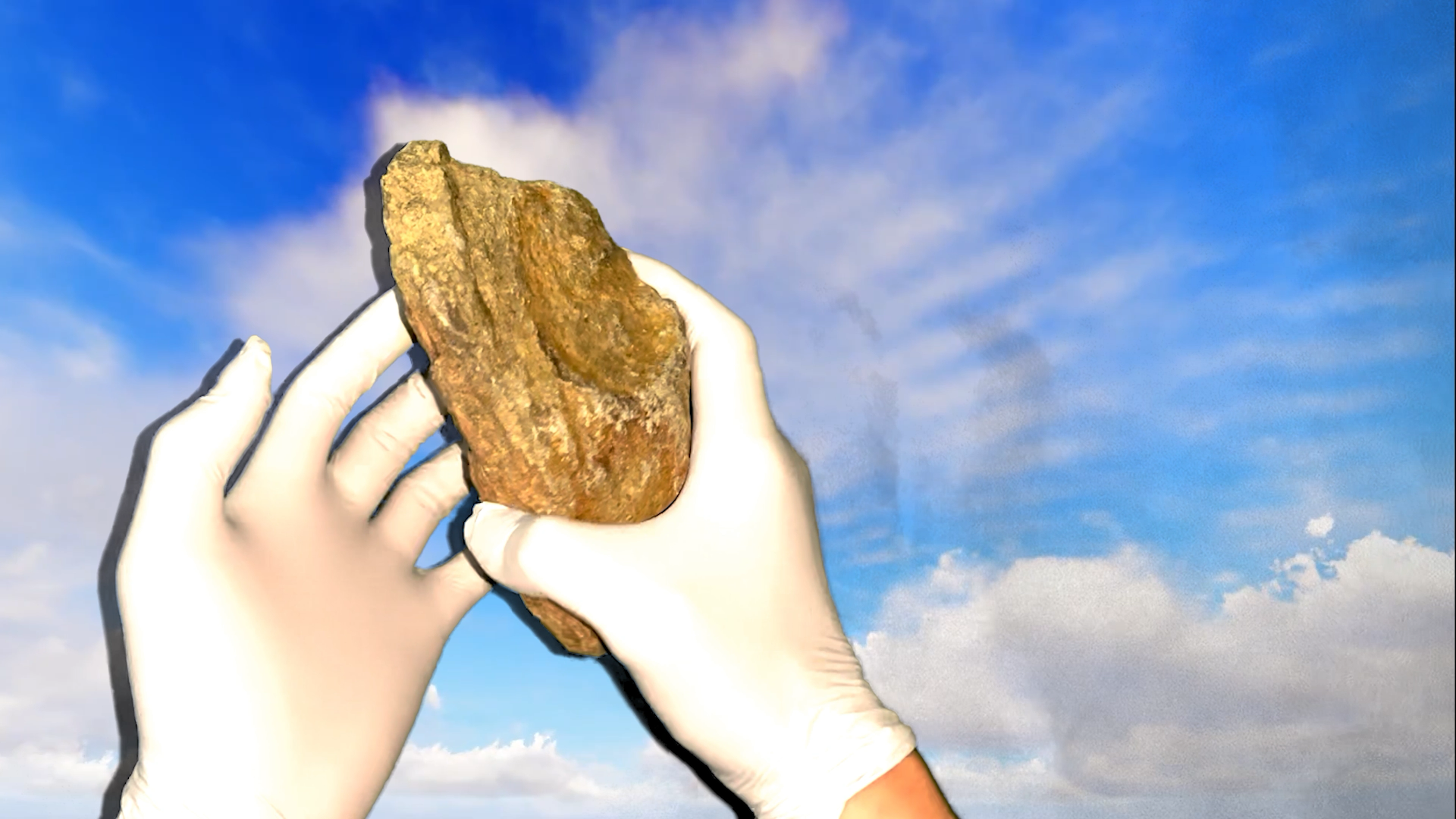
2022, in the summer, on my way down from a mountain, I picked up a small stone.
At the time, I was addicted to crypto futures trading and NFT trading. For nearly half a year, I lived with my eyes fixed on the charts of overseas exchanges and OpenSea, and after losing a few million won, I wanted to die. I started hiking up the ridgeline on the slopes of Gwangdeoksan in Cheonan because I needed to breathe again, even just a little.
I thought the mountain air, the smell of the brush, and the sight of little squirrels might calm me down. But unlike the wind, the afterimages of charts stuck to my eyes kept overlapping the trail, overlapping the mountain itself, and branches and trunks looked like bullish and bearish candlesticks. (Down in the valley water, it even smelled like shit.)
I climbed down to the stream, skipped stones, and searched for smooth, shiny pebbles, busily moving both hands and feet as I rummaged through reeds in the water. (Was there any gold nugget lying around? Whenever I looked at photos from the nineteenth-century American Gold Rush, scenes of people standing in water panning for gold kept flickering in my mind. As if there would be.)
After wandering along the stream for a long while, I picked up a stone about the size of a full handful. Maybe because it was coated with dirt, it even had a faint golden tint. I caught myself wondering how much it would be worth if a gold nugget were this big, and then my thoughts ran ahead: if I suddenly had money in hand, how much I’d set aside, how I’d spend it and save it, how I could cover rent and a deposit, how I could buy my mom and dad sushi. (Omakase. With just the money I lost trading futures, our family could probably have gone fifteen times.)
In a good mood, I put the stone in my bag and got on the bus, and I remember the ride home feeling oddly long.
When I got home, I rinsed the stone under tap water and left it to dry in the sun, but my mom nagged me endlessly, asking why on earth I had brought that rock back. So I said, “Mother, the body is gathered through the four conditions of earth, water, fire, and wind (地水火風), so this stone and I are ultimately beings of dependent origination. And Master Zhaozhou said even a dog has Buddha nature (佛性), so you mustn’t look down on a stone.” Then I got smacked on the back (my mom is a deacon at church), and she told me to stop talking and go eat, so I went back to my room and dried the stone with a hair dryer.
Once it was completely dry, I scanned it with a 3D scanning app that was out at the time and saved it on my phone. Turning my fingers this way and that, I tried to gently feel the materiality of the stone on the screen, and of the thing that was neither stone nor not stone. If someday some kind of technology advanced in this way and that, could it turn a real stone into gold? In an era with that level of technology, maybe you wouldn’t just turn stones into gold, you’d turn them into rice. (Would a society ever come where it’s fine to trade gold for bread and eat it?) Maybe you could even turn shit into rice. But would that world be a better world?
In Understanding Media, McLuhan says that technology, the computer, promises humanity a world that carries a Pentecostal condition of universal understanding and unity. But he adds a qualifier along the lines of “the next logical step would seem to be,” a premise that admits we cannot really predict the future technology will bring. Tech optimists always prophesy that “better technology” will save humanity. Logically, it sounds plausible.
I thought so too. I believed faster, more precise technology would make up for human lack and seal the cracks in the world. For a while, I didn’t realize that belief had a texture similar to faith. Staring at charts, holding my breath and exhaling with every rise and fall of the graph, it resembled the rhythm of prayer. The only difference was that what I fixed my gaze on was not an icon, but lights made of pixels. I called that light “data,” and mistook it for the real structure of the world.
Looking back now, that belief also resembled gold. A dazzling thing that can’t be grasped, a mirage like substance that evaporates the moment you touch it. People called it opportunity, and I called it salvation. Ever since the day I picked up that stone, I’ve often thought: maybe gold isn’t matter but language. Some languages turn stones into gold; other languages turn gold into trash. If we enter an era where technology replaces that language, do humans end up losing the form of belief and leaning instead on fragments of signs?
I still hold the stone. Its weight in my palm is about 0.3 kg, but on the screen it is infinitely light. On the screen, the stone has no shadow, no smell, no coldness of water. Instead, it sparkles, because it catches the light well. Light stains everything with a golden hue. But I’m increasingly afraid of that gold. It’s a color that feels more real than the real.
So sometimes, while staring at the stone scanned in 3D, I let it go from my hand. I recall the phrase “a better future” that technology promised, and I ask myself whether it is truly the future, or another simulacrum of belief. If we can turn stones into gold, then haven’t we, in the end, reinvented God?
(excerpt from the work note)